Our new challenge: the soft tissue issue
In this newsletter:
- Joe's blog
- Time to focus on the soft tissue issue
- Final hours! Feedback on drugs & alcohol policy closing
- Have your say on the future of forestry vocational training
- Wāhine in Forestry Conference coming up
- Check out our ‘Beat the heat’ campaign on Facebook
Joe's blog
The tissue issue
I’ve said it before and I’ll say it again: we should be proud of how far we’ve come in forestry safety over the past decade. Fatalities are down dramatically - and that’s no small achievement. But this isn’t the finish line - not even close.
We’re entering a new phase of safety - one that’s just as challenging as reducing fatalities. Now the job is to hold the line on those big gains and go further, we want to get everyone home safely, every day. We also want to dig deeper into the injuries that continue to occur day in, day out. All sources of harm need to be addressed.
Injuries that put people off work for weeks don’t just hurt the person who’s injured. They hit families, bank accounts, crews and businesses. And the latest ACC data makes something very clear: we’ve got a tissue issue - a soft tissue issue, to be exact.
Injuries like sprains, strains and bruises are consistently making up more than half of all forestry ACC claims that require more than five days off work. That’s a huge signal about where we need to focus next.
We’ve broken down the details below. But for now, start thinking about your day-to-day tasks. Where could a sprain or strain creep in? And what simple changes could stop it before it happens?
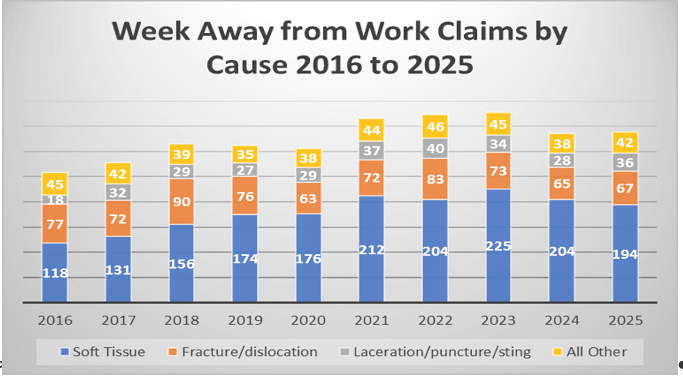
It’s time to focus on the soft tissue issue
(Graph from Safetree, based on ACC data)
Soft tissue injuries are quietly becoming one of forestry's biggest safety problems. New FISC work on ACC data shows that sprains, strains, and similar injuries consistently account for more than half of all ACC forestry claims requiring more than five days off work.
ACC defines soft tissue injuries as damage to muscles, tendons, ligaments, cartilage, nerves or other soft tissue - think torn ligaments, muscle strains, whiplash or repetitive strain injuries.
While the total number of soft tissue claims peaked in 2021, they’re consistently claiming a bigger slice of all forestry injuries:
• 58% of all forestry claims in 2025,
• up from 47% in 2017,
• and higher than the 54% peak in 2021.
“Soft tissue injuries have been falling less quickly than other claim types,” says FISC chief executive Joe Akari. “That makes them a sticking point - and an area the industry needs to focus on. Fewer severe injuries mean fewer ACC claims, and that’s better for everyone.”
The cost trend is moving the wrong way too. The average soft tissue claim cost has jumped 50% in just five years:
• 2020–22: 1,933 claims costing $15.6m (avg. $8,060)
• 2023–25: 1,508 claims costing $18.1m (avg. $12,000)
And last year alone, for forestry ACC received:
• 194 soft tissue claims needing more than five days off, versus
• 67 fractures/dislocations,
• 36 lacerations or punctures, and
• 42 other injuries.
That means more than half of all serious time-loss forestry injuries are soft tissue injuries.
“The next step is understanding what’s causing them,” Akari says. “Once we pinpoint the drivers, we can start reducing them — and we’ll share more as we work through the data.”

Final hours! Feedback on drugs and alcohol policy closing
The final date for feedback on FISC’s Drugs and Alcohol Good Practice Guide and Policy for Fitness to Work is this Friday, 13 February 2026.
This is the first review in over a decade, so it's important that you have a say in shaping it.
FISC wants to hear from contractors, forest owners, forestry workers and anyone else involved in the industry. Tell us what works, what doesn’t, and what you need.
Have your say on the future of forestry vocational training
The Forestry Training Committee are urging industry members to take part in regional consultation sessions this March and April, aimed at shaping the future of forestry vocational training. This is in response to the Government’s ongoing reforms of the vocational education system.
The consultation sessions will be led by Committee Chair Kevin Ihaka, alongside Rowan Struthers (Forest Industry Contractors Association) and Joseph Brolly (Forest Owners Association), with support from Competenz. Each 60-minute session includes a presentation followed by Q&A and open discussion. The Forestry Industry Training Committee comprises FICA and FOA representatives.
Sessions will be held in Whangārei (4 March), Rotorua (6 March), Gisborne (11 March), Balclutha (30 March), and Nelson (1 April). An online session will also be available on 31 March although participants are encouraged to attend in person if possible.
The Tertiary Education Commission requires clear evidence of sector engagement before any preferred training delivery option can be confirmed. Your feedback will directly inform the committee’s advice to Government later in April, making industry participation essential.
Over the past year, the Forestry Training Committee has undertaken extensive due diligence to determine the best long-term home for forestry vocational training and wants your feedback on its proposed direction. The Committee’s goal is to ensure better support for learners and employers, with suitable training and assessment.
Key topics for the sessions include:
• The impact of Government reforms,
• Competenz’s transition away from providing forestry training, to be picked up by the Food and Fibre Industry Skills Board,
• The committee’s preferred alignment with Primary ITO as it becomes a Primary Industry Private Training Establishment,
• A proposed model giving forestry its own dedicated training division and governance representation.
• Priorities for forestry training such as protecting the existing network of contract trainers and assessors, forestry knowledge and the skills currently within Competenz and keeping training practical, learner-focused and easy to manage.
With more than 85 percent of forestry training delivered on the job, maintaining strong, effective vocational pathways is vital for safety, productivity, and workforce development. The committee is eager to hear what is working well, what must be protected, and any concerns you may have.
Wāhine in Forestry Conference coming up
If you’re a woman working in the forestry sector, this one’s for you!
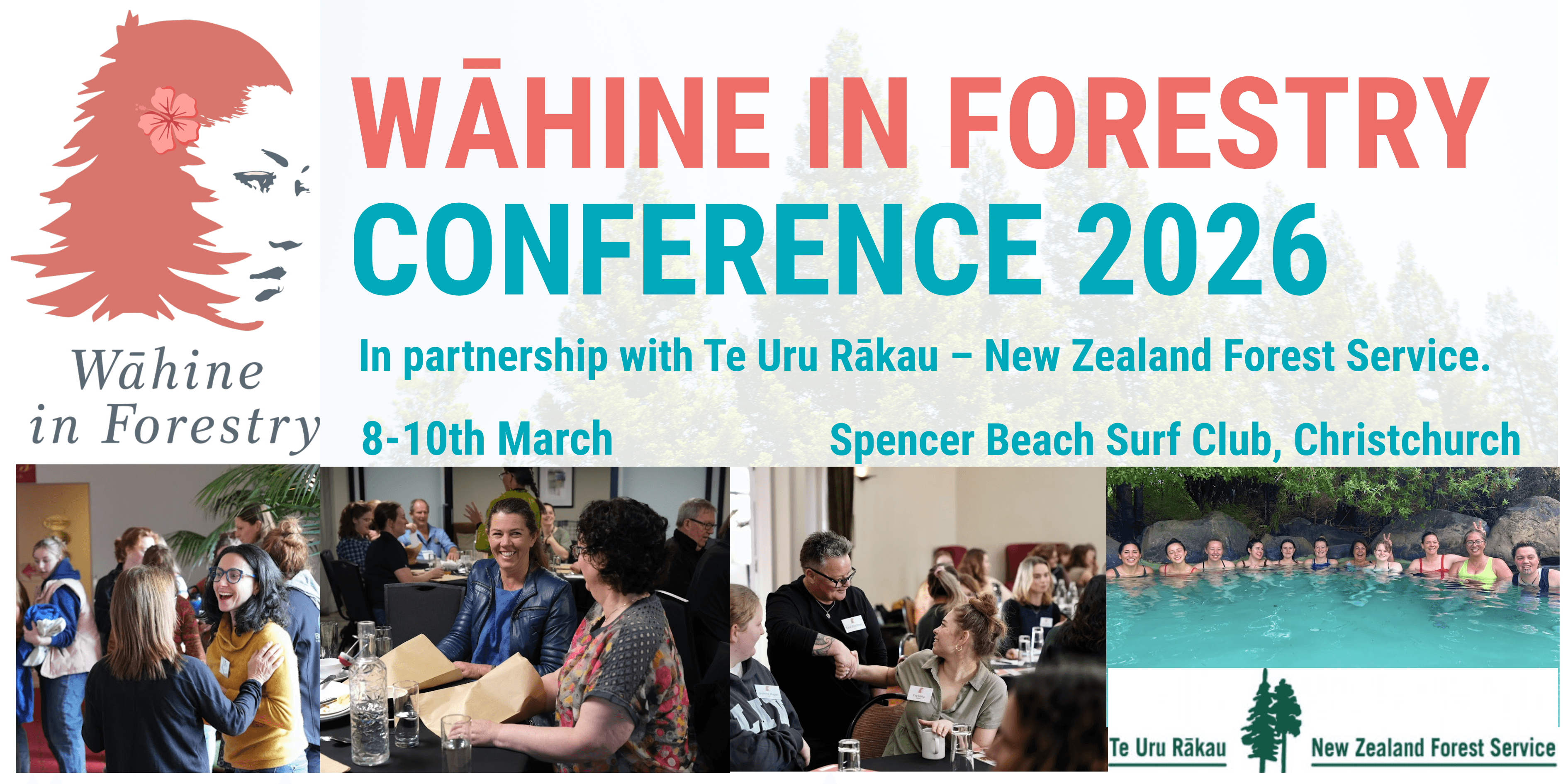
The annual Wāhine in Forestry Conference is being held 8-10 March this year at the Spencer Beach Surf Club in Christchurch.
Educational psychologist Maria McKenzie, who has a passion for guiding businesses to boost employee productivity and happiness, will be the conference facilitator, with Dr Denise Quinlan, Founder of the NZ Institute of Wellbeing and Resilience also presenting.
In addition, there will be a cross-industry panel discussion featuring Women in Dairy, Wine, Horticulture and Geothermal and a fun, optional fitness session to get the body moving and the energy flowing.
Students studying approved forestry courses can attend free.
Check out our ‘Beat the heat’ campaign on Facebook
Summer may have taken a while to settle down, but it feels like it might finally be here.
So remember to take extra care in the sun when you’re at work, to help prevent fatigue and keep yourself healthy.
Check out our Facebook page for tips on how to Beat the heat this year.